Lists, contacts, fields. The foundation under every campaign.
A layered data model with first-class custom fields, a guided CSV/TXT import wizard, bulk operations, and list-level split / merge / copy / export. Built for senders who treat their audience as a first-class asset.
Mumara organises your audience in layered tiers — each with its own role. Master the model and every other feature (Segments, Triggers, Drips, Broadcasts) follows naturally.
Lists
Top-level containers. Each list has its own sender name, sender email, reply-to, additional headers, and assigned set of Profile Fields. Group lists for organisation. Multiple lists per account — segment your audience by source, product, or programme.
Contacts
The records on each list. Email + standard status flags (Confirmed, Bounced, Unsubscribed) + whatever Profile Fields the list defines. View/search/edit per contact, or operate on thousands at once via Bulk Update.
Profile Fields
Custom field definitions managed at the admin level. Text, Number, Date, Dropdown, Multi-value, URL — extensible field types defined once and assigned to any list. The real differentiator vs platforms that limit you to tags or a fixed schema.
The guided import wizard
Step 1 to step 3. With a preview before you commit.
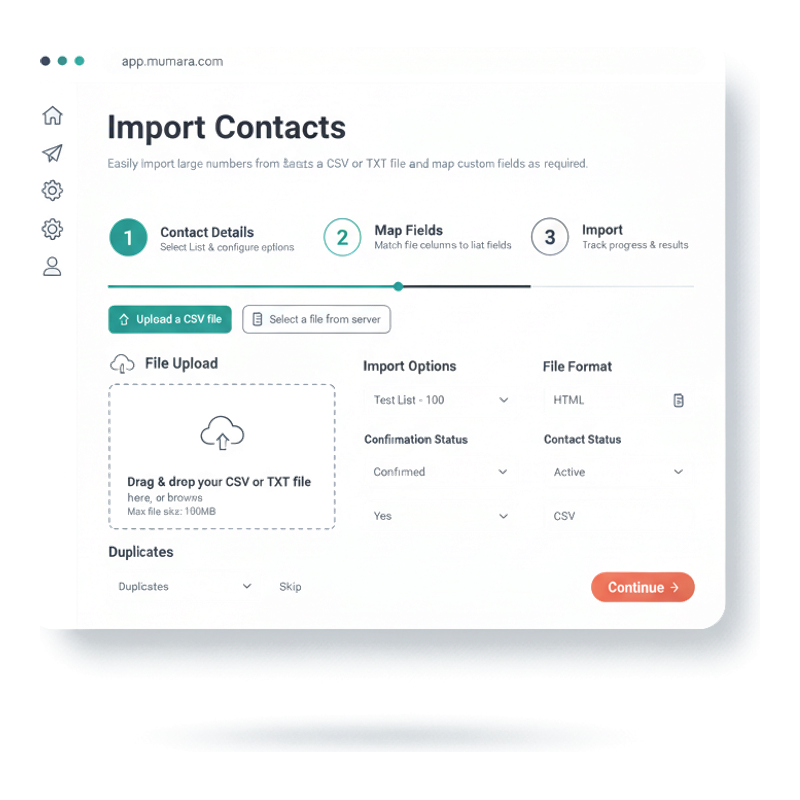
Upload a CSV or TXT file (up to 100MB). The wizard's step indicator stays visible all the way through so you never lose your place. Step 2 maps columns with a data preview — actual first-3-rows shown beside each field's dropdown — so you confirm the mapping before commit. Step 3 reports live progress with TOTAL / IMPORTED / DUPLICATES / INVALIDS counters.
CSV or TXT, up to 100MB
Drag and drop, or browse, or pick from a server file. Mumara reads CSV and TXT — whatever your source system exports.
Visual column mapping
Data Preview toggle shows the first 3 rows of your CSV in brackets beside each column name — e.g., First Name (Michael, Michael, Michael). You see exactly what'll land in each field before clicking Continue.
Duplicate handling, your choice
On the import options panel, set Duplicates to Skip / Update / Overwrite. Mumara honours the choice per row — duplicates surface in the final results panel as a separate counter so you know exactly what landed.
Override creation date
Importing historical data? Toggle Override Creation Date and Mumara timestamps each record with its real signup date rather than today's. Crucial for accurate lifecycle reporting.
Multiple ways in
One contact record. Multiple ways to create it.
The form, the wizard, and the API all converge on the same contact record. Pick the path that matches the source — manual, bulk file, programmatic.
Add a Contact
Single record · form
From Contacts → Add a Contact. Pick the list, paste the email, fill out the standard fields and any custom fields the list defines. Save · Save & Add New · Cancel. The fastest path when you have one or two records to enter manually.
Import Contacts
CSV or TXT · guided wizard
Upload a CSV or TXT file up to 100MB. Column-mapping step lets you visually confirm field mappings against a data preview before commit. Progress step shows a live bar with TOTAL / IMPORTED / DUPLICATES / INVALIDS counters. Reusable for re-syncs.
API
Programmatic · per-record
Push contacts in via the REST API for CRM sync, signup-form proxies, integration platforms, or batch jobs. The form, the wizard, and the API all converge on the same contact record — same fields, same validation, same downstream behaviour.
Lists in Mumara are operational objects. Bulk update thousands of records via CSV. Split for cohorts. Merge for consolidation. Copy for snapshots. Export to CSV any time. The data is yours — Mumara never holds it hostage.
Bulk Update
CSV-driven mass modify. Upload a file, select target lists, pick an action, hit Submit. Update thousands of records in a single operation.
Split
Divide one list into N smaller lists by percentage, by field value, or by sample. Useful for A/B groups, holdout cohorts, or batch sending.
Merge
Combine two or more lists into one. Mumara deduplicates by email so a contact who appears in both lists lands once in the merged result.
Copy
Duplicate a list (or a filtered subset) into a new list. Useful for archiving snapshots or branching a campaign-specific cohort without disturbing the source.
Export to CSV
Pull any list — full or filtered — as CSV. Plug into your warehouse, share with a stakeholder, or migrate to another system. No data lock-in.
The cost of a sloppy database
Why contact data quality compounds.
Every campaign you'll ever send rests on the contact records under it. The cost of skipping list hygiene shows up everywhere — deliverability, reporting, compliance.
Duplicates inflate your bounce rate
If the same person appears in your database three times under slightly different emails, each campaign multiplies their bounce risk by three. Mumara's import wizard surfaces duplicates as a counter and lets you choose Skip / Update / Overwrite per import.
Missing fields cripple personalization
If half your contacts don't have a 'plan tier' or 'country' field populated, every personalization rule that depends on that field renders the fallback — and your campaign reads generic to half your audience.
Stale lists drag down sender reputation
Lists that haven't been cleaned in months accumulate dead addresses. Each send to a dead address dings your reputation a tiny bit; thousands of them compound. Mumara's bounce processing + list operations let you re-cohort and prune without manual triage.
You can't segment what you didn't capture
If 'signup source' isn't a field, you'll never segment by it. Capturing the right Profile Fields at intake is the cheap-now / expensive-later decision that distinguishes good email programmes from great ones.
“The contact-management system is the quiet hero. Custom fields, bulk import, and the way segments and triggers all reference the same fields — everything connects. Our migration off a previous ESP took an afternoon instead of a week.”
Verified review
Mumara customer
Trustpilot
Common questions
What buyers usually ask.
What's the difference between a List and a Group?
A List is the actual contact container — records live in lists, and every contact belongs to at least one. A Group is an organisational label for grouping related lists in the Lists view (e.g., a 'Customer Lists' group, a 'Marketing Lists' group). Groups are for your sanity in the admin UI; Lists are the data structure that campaigns target.
What file formats can the Import wizard handle?
CSV and TXT. Drag-and-drop or browse, or pick from a server file. Maximum file size 100MB per import. For larger datasets, split the file into chunks or use the API. Mumara reads the standard CSV dialect (comma-separated, double-quoted strings) and auto-detects whether the first row is a header.
How does deduplication work?
On import, you pick a Duplicates strategy: Skip (ignore rows whose email already exists on the target list), Update (replace existing record's fields with the import row's), or Overwrite (delete the existing record and create new). The wizard's step-3 results panel shows how many records hit each path so you know exactly what changed.
Can I customize the fields on each list?
Yes — and that's what [Custom Fields](/campaigns/features/custom-fields/) are for. Define a field once at admin level (Lists → Custom Fields → Add), assign it to any list that should capture it. Each list can have its own set of assigned fields, or share definitions across lists. Field types include Text, Numeric, Multiline, Checkboxes, Dropdown, Radio, Date — each with its own type-specific segmentation operators. See the [full Custom Fields page](/campaigns/features/custom-fields/) for the field model, naming rules, group ordering, and the downstream features that read from this layer.
What's the difference between Bulk Update and the Import wizard?
Import creates new contacts (or updates existing ones based on the Duplicates strategy). Bulk Update modifies existing contacts at scale — change a field value across N contacts, move records between lists, apply a bulk status change. Bulk Update takes a CSV file with the list of contacts to modify and the operation to perform.
Can I split or merge lists?
Yes. From the Contact Lists view, per-list actions include Split (divide a list into smaller cohorts by percentage, field value, or sample), Merge (combine two or more lists into one with email-based dedup), Copy (duplicate a list — full or filtered subset), and Export to CSV (any list, any time). The contact data is yours.
How do contacts get from a web form into a list?
Web Forms (see /campaigns/features/web-forms/) write directly into a target list. New signups land as Confirmed (or Pending, if double opt-in is enabled), with consent metadata captured per submission. Forms are the most common automated source; the API and CSV import handle the rest.
Can multiple admins manage contacts independently?
Yes. Mumara has role-based access — see Administrators and User Management features. Admins can scope users to specific Lists, give them custom permissions (read-only on some lists, full edit on others), and audit every change via the activity log. Useful for agency / reseller setups with isolated client data.
Bring your audience in. Build everything else on top.
Contact Management ships with every Mumara Campaigns plan — both Self-Hosted and Mumara Machine. Free trial includes the full audience toolkit. Bring a CSV and have your first list imported in five minutes.